
Beyond "opt out of training": how confidential computing defines data sovereignty in the AI era
This guide explains how TeeChat tackles privacy sovereignty in the AI era through underlying hardware architecture — without giving up compute efficiency.
What follows is the deep dive behind four privacy questions on our homepage FAQ — full mechanism, comparisons, and references.
If you already know the data sovereignty ladder and how to verify confidential chat, this post answers four objections at the mechanism level.
Core analysis: the myth of “plaintext inference”
Common misconception
AI has to see plaintext during inference to produce an answer. If the data is ultimately “read,” isn’t server-side privacy just comfort marketing?
Deep dive
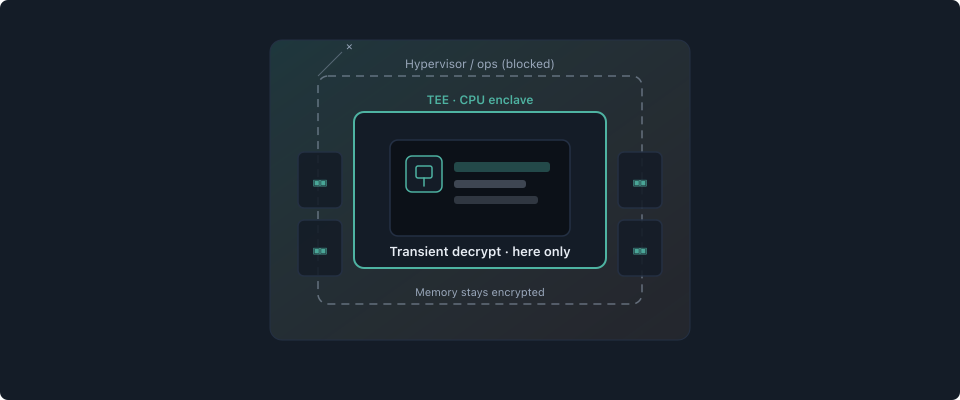
That is a sharp observation. In conventional cloud AI, data lives in memory as plaintext. Anyone with root on the box — or the cloud operator — can dump memory and recover your sensitive content.
TeeChat uses hardware confidential computing — Intel TDX (Trust Domain Extensions) and AMD SEV (Secure Encrypted Virtualization).1 The design isolates compute in hardware:
- Encrypted memory → hardware decrypt — Guest memory stays encrypted under hardware protection; plaintext exists only while the CPU executes inside the TEE.1
- Privilege stripped — Decryption is enforced by silicon, not software promises. The hypervisor and host operators cannot read plaintext guest memory.1
- Conclusion — The goal is not to keep the model from “seeing” your prompt. The goal is to ensure decryption happens only inside a hardware-isolated TEE — invisible to privileged software, including cloud operators and admins.1
On TeeChat, the routing server forwards sealed ciphertext only; the open-source inference engine decrypts inside an attested TEE to run the model. You can Verify attestation under Settings against the platform manifest — see How to verify confidential chat.
Myth 1: “I turned off training — I’m safe”
Common misconception
I disabled “use for training” in the model settings. My data won’t be harvested — that’s enough.
Deep dive
This conflates two different guarantees:
| Training privacy | Access privacy | |
|---|---|---|
| What you get | Chat is not baked into model weights | During inference, plaintext still flows in vendor RAM |
| Protects against | Future users jailbreaking your info out of weights | Vendor, ops, or anyone with prod access reading now |
| TeeChat path | We do not host chat archives; hosted sends use sealed encryption | TDX/SEV limits decryption to the hardware enclave |
TeeChat’s approach: We do not rely on a vendor promise — we rely on hardware enforcement. With TDX/SEV, visibility of your data across the inference lifecycle stays inside the isolated enclave.
Myth 2: “Redaction fixes everything”
Common misconception
If I strip names, phone numbers, and company names, the rest is safe to send to AI.
Deep dive
Redaction worked in the pre-LLM era. With large models, inference attacks are a serious risk:
Models excel at pattern matching. Even without explicit IDs, domain jargon, argument structure, and writing style can fingerprint you — re-identifying the subject from “anonymous” text.
TeeChat’s approach: If redaction is weak against strong AI, the durable fix is environment isolation. Skip the redaction treadmill: put the full document in a hardware-isolated enclave and let the model work in a private black box — while keeping 100% context for quality (next section).
Myth 3: “Only the biggest model is good enough”
Common misconception
Without a frontier model like GPT-5.6 or Fable 5, complex professional work must suffer.
Deep dive
This mixes up model capacity with task outcome. Parameter count is not the only variable — context completeness often matters just as much, and for concrete professional work it can be decisive.
The conclusion rests on three evidence-backed mechanisms.
1. Information loss is irreversible
Evidence logic: In retrieval and generation tasks, input signal-to-noise ratio caps output quality.
Mechanism: De-identification is lossy compression. Strip names, companies, dates, or domain terms and you lose more than privacy — you lose semantic correlation, the anchors models use to chain reasoning.
Evidence: Chen et al.’s RGB (Retrieval-Augmented Generation Benchmark) shows that when retrieved documents miss key facts, add noise, or fail to integrate, LLMs still produce clear errors or hallucinations — retrieval/context quality caps generation faithfulness.2
Conclusion: Frontier models process faster; they cannot reliably invent facts absent from the input. Missing input means unreliable output.
2. Context–performance correlation
Evidence logic: For concrete, complex professional tasks (contract review, clinical reasoning), context completeness often outweighs parameter count.
Mechanism: LongBench and similar long-context benchmarks show that on long-document tasks, model performance depends heavily on complete, coherent input.3
Evidence: Domain fine-tuning studies show mid-size models trained on high-quality domain data can significantly improve on that domain without necessarily losing all generalization.4
Conclusion: Frontier models excel at generalization (breadth). Professional work needs precision (this case). Full context supplies precision; scale supplies breadth — they are not interchangeable.
3. “Lost in the Middle” and information density
Evidence logic: Longer context is not automatically better — density and completeness of what matters often decide success.
Mechanism: LLMs exhibit “Lost in the Middle”: they remember beginnings and endings best; middle sections fade.5
Inference: Privacy-driven fragmentation compounds the “weak middle recall” in 5 with the “incomplete context” failures in 2, making coherent reasoning chains harder and performance more fragile.6
Conclusion: A mid-size model fed a complete, continuous prompt often beats a frontier model fed sanitized fragments — attention works better on intact structure.
TeeChat in practice: Hardware privacy means you need not trim prompts. Ship 100% of the source material. In privacy-sensitive professional work, that context compensation is often more practical than chasing the largest checkpoint.
Summary
| Myth | Key distinction | TeeChat answer |
|---|---|---|
| Plaintext is inevitable | Model must read data ≠ ops must read RAM | Transient TEE decrypt; router never decrypts |
| Training opt-out is enough | Training privacy ≠ access privacy | Hardware enforcement + no hosted chat archive |
| Redaction is enough | Removing IDs ≠ blocking re-identification | Full data in hardware isolation |
| Only the biggest model works | Parameters ≠ outcome | Full context compensates; three evidence pillars above |
Next: Before you paste sensitive material, verify the engine in Settings and point reviewers to our open-source components OPE and the Rust inference engine — see Evidence, not confidence.
Try it: chat.teechat.ai · Desktop: teechat.ai/download
References
Footnotes
-
AMD, SEV-SNP: Strengthening VM Isolation with Integrity Protection and More — encrypted guest memory; hypervisor cannot read guest plaintext. AMD SEV-SNP whitepaper · Intel, Trust Domain Extensions (TDX) — trust-domain isolation and memory protection. Intel TDX documentation ↩ ↩2 ↩3 ↩4
-
Chen et al., Benchmarking Large Language Models in Retrieval-Augmented Generation (AAAI 2024) — RGB benchmark; LLMs fail when retrieval is missing, noisy, or hard to integrate. arXiv:2309.01431 ↩ ↩2
-
Bai et al., LongBench: A Bilingual, Multitask Benchmark for Long Context Understanding (ACL 2024) — long-document performance correlates with context length/completeness. arXiv:2308.14508 ↩
-
Sun et al., Dial-insight: Fine-tuning LLMs with High-Quality Domain-Specific Data Preventing Capability Collapse (2024) — domain fine-tuning improves specialized performance. arXiv:2403.09167 ↩
-
Liu et al., Lost in the Middle: How Language Models Use Long Contexts — performance drops when relevant facts sit in the middle of long inputs. arXiv:2307.03172 ↩ ↩2
-
Synthesis from 2 and 5: fragmentation amplifies both incomplete context and weak mid-sequence recall (not a single-paper finding). ↩
Revision log
- Point open-source engine links to teechat-inference-engine-rust (Rust production train).